Employer burden calculator for total employee cost
Enter salary, state, benefits level, and risk profile to estimate total employee cost, employer payroll cost, burden rate, and annual hiring cost for a W-2 employee.
Have more than one employee? Paste your payroll list
One employee per line: name, then pay, and optionally a two-letter state. Tabs, commas or semicolons all work, so a paste straight out of a spreadsheet is fine. Rows without a state use the work state selected above. Everything stays in your browser.
Paste a list and select Calculate the list.
| Employee | State | Pay | Burden | Total employer cost |
|---|---|---|---|---|
| Total |
Midpoint estimate per employee using the role, benefits, SUTA and admin settings above. Planning estimate only — not payroll, tax, legal, insurance, or HR compliance advice.
Estimated annual cost
$0 - $0
Federal payroll taxes are high-confidence. SUTA and workers compensation are planning estimates unless you enter assigned rates.
Example estimate shown. Enter your inputs and select Calculate to create a current result.
Free first-party options
Choose what happens next
Email the estimate and checklist, or request a free reviewed-plan pilot. Neither option requires payment. This is general information, not payroll, tax, legal, insurance, or HR advice.
Current context: Calculate a current estimate to attach its state and salary band.
Use this estimate to decide whether payroll software, a PEO, or an HRIS platform fits the hire.
General planning estimate only. Not payroll, tax, legal, insurance, or HR compliance advice.
From estimate to decision
Plan one hire, compare locations, or build the whole headcount budget
Every tool uses the same sourced 2026 engine, so assumptions stay consistent as the decision grows.
Work backward from the total annual or monthly employer budget to a conservative salary ceiling.
Open hiring budget calculator → Location decision Where should we hire?Compare the same role across two to four states without changing salary, benefits, or risk assumptions.
Compare states → Headcount plan What will the team cost?Add roles, headcount, start dates, salaries, and states to produce a monthly and annual hiring plan.
Build a private hiring plan → Implementation cost Payroll, PEO, or EOR?Estimate public provider fees from headcount and operating model before requesting a quote.
Compare provider costs → Data provenance Inspect every official sourceSearch and download the wage bases, rate models, status, and source links behind all 51 jurisdictions.
Open source ledger → Advisor distribution Put EmployerCost on your siteSelf-install the attributed widget free, or request one basic branded installation for a proposed US$99 one-time price.
Compare free and branded options →Employer burden calculator
What this employer burden estimate answers
The employer burden rate is the percentage added above base salary to estimate the full cost of a W-2 employee. This calculator combines salary with employer-paid payroll taxes, state unemployment assumptions, workers compensation, benefits, and payroll administration.
Formula: (total employer cost − salary) ÷ salary. Change the state, benefits, risk profile, or SUTA assumption to see how each input changes the estimate. Actual payroll cost still depends on your assigned rates, class code, carrier, and plan pricing.
Employer burden calculator FAQ
What does an employer burden calculator include?
It estimates salary plus employer-paid payroll taxes, state unemployment assumptions, workers compensation, benefits, and payroll administration.
How do you calculate the employer burden rate?
Subtract salary from total employer cost, then divide by salary. The result is the percentage added above base pay.
Why does employer burden change by state?
State unemployment wage bases and rates, workers compensation assumptions, paid leave programs, and local obligations can change the estimate. See the employer burden rate guide for the formula and state benchmark table.
State-specific planning
Calculate employer cost in all 50 states and DC
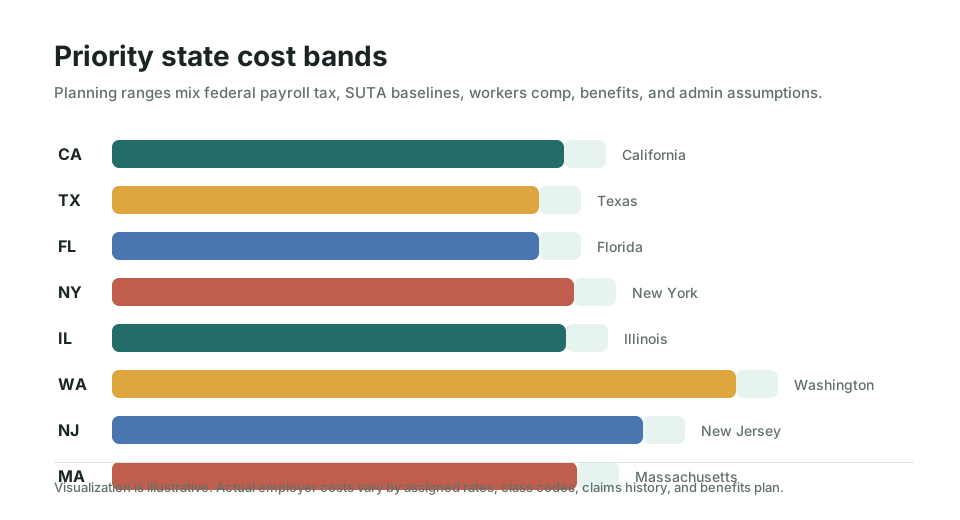
Explore 51 dedicated state guides with sourced 2026 SUTA assumptions, state-specific caveats, and a direct path into the calculator.
Provider short-list
Compare payroll, PEO, HRIS, and global hiring options after the estimate
Provider comparisons are informational. Tracked partner links will appear only after a program approves EmployerCost; a click is never presented as revenue.
Employee cost formula
What employer cost includes beyond salary
Employer cost usually starts with wages, then adds employer-paid payroll taxes, state unemployment assumptions, workers compensation, benefits, and payroll administration. The calculator keeps variable items as ranges because actual cost changes by state, industry, class code, carrier, and employer history.
- Use the state directory when the hiring location drives the estimate.
- Use the employer payroll tax calculator and the payroll tax guide to separate employer taxes from employee withholding.
- Use the methodology when you need to see which inputs are high-confidence and which require employer-specific verification.
total = salary + FICA + FUTA + SUTA + workers_comp + benefits + admin
workers_comp = (salary / 100) * rate_per_100
suta = min(salary, wage_base) * employer_rate